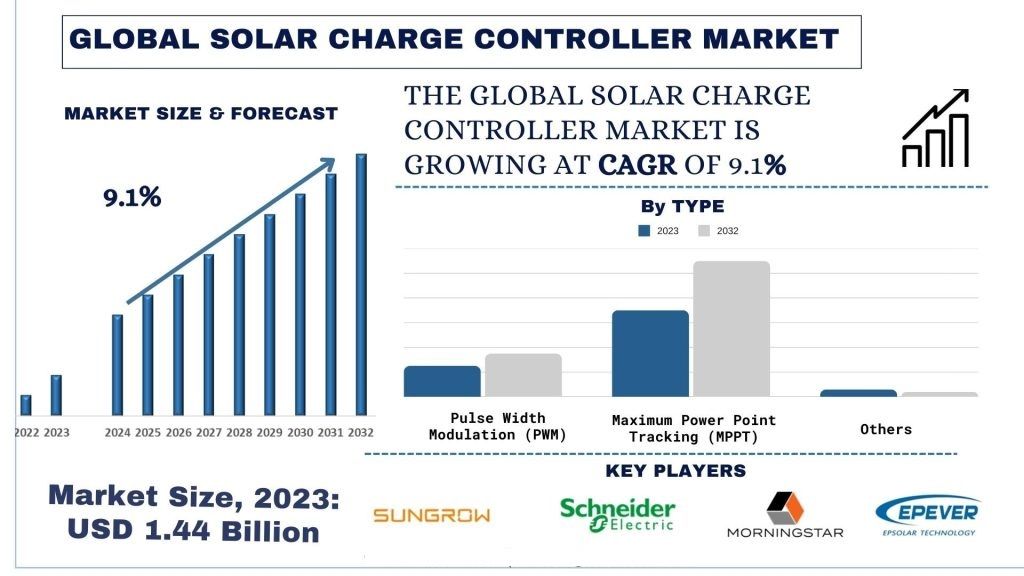
According to the UnivDatos, the rising sales of solar panels will drive the global scenario of the Solar Charge Controller market. As per their “Solar Charge Controller Market” report, the global market was valued at USD 1,441.2 million in 2023, growing at a CAGR of 9.1% during the forecast period from 2024 – 2032 to reach USD 3,181.9 million by 2032.
Solar charge controllers are essential components in solar power systems that regulate the voltage and current from the solar panels to the battery. They prevent batteries from overcharging, damaging the battery, and reducing lifespan. Solar charge controllers regulate the voltage and current by adjusting the output of the solar panels to match the battery’s voltage and charge requirements. The solar charge controller market is a rapidly growing industry driven by the increasing demand for renewable energy sources and the need to reduce carbon emissions. The market for solar charge controllers is highly competitive, with numerous manufacturers offering a wide range of products with different features and specifications. For example, some controllers have LCDs, USB ports, and multiple load control modes, making them more versatile and user-friendly. Price, standards, and regulations drive the market for solar charge controllers. Standards such as IEC 61215, 61646, and 61730 ensure the quality and safety of solar modules, while UL 1703, 1741, and 2703 set the standards for electrical safety and performance.
Access sample report (including graphs, charts, and figures): https://univdatos.com/reports/solar-charge-controller-market?popup=report-enquiry
Government Schemes:
There has been a rise in demand for renewable energy, and many countries are planning to diversify their energy portfolio to become less dependent on conventional sources of energy. Most governments have started addressing climate issues and introduced many new renewable energy schemes to reduce carbon emissions globally. Governments worldwide are coming together for initiatives such as the Paris Climate Agreement, which is acting as a catalyst in the growth of the Solar Charge Controller Market.
Along with national schemes, various policy types drive Solar PV capacity growth, including auctions, feed-in tariffs, net metering, and contracts for difference.
Some of the policies that are majorly impacting the Solar Charge Controller market are –
Ø China published its 14th Five-Year Plan in June 2022, which includes an ambitious target of 33% of electricity generation from renewables by 2025 (up from about 29% in 2021), including an 18% target for wind and solar technologies.
Ø In August 2022, the federal government of the United States introduced the Inflation Reduction Act, a law significantly expanding support for renewable energy in the next ten years through tax credits and other measures.
Ø In July 2021, the European Commission proposed to increase the bloc’s renewable energy target for 2030 from 32% to 40%. The REPowerEU Plan further increased the proposed target to 45% in May 2022 (which would require 1 236 GW of total installed renewable capacity, including 600 GW of solar PV). Many European countries have expanded their solar PV support mechanisms to accelerate capacity growth in response to the 2030 targets and the energy crisis caused by Russia’s invasion of Ukraine.
Ø During COP26, held in November 2021 in Glasgow, India announced new 2030 targets of 500 GW of total non-fossil capacity, a 50% renewable electricity generation share (more than double the 22% share in 2020), and net zero emissions by 2070. Solar PV was one of the leading technologies used to achieve these goals.
Increasing Investment from the Private Sector:
Private companies are driving the growth of the Global Solar Charge Controller Market
Globally, The private sector’s main activity in solar energy deployment can be divided into two categories:
Ø Companies investing in distributed (including rooftop) solar PV installations on their buildings and premises – are responsible for almost 30% of total installed PV capacity as of 2021.
Ø Companies entering into corporate power purchase agreements (PPAs) – signing direct contracts with solar PV plant operators to purchase generated electricity. Solar PV plants dominate renewables PPAs, with a share of almost 75% in 2020.
U.S. businesses and top global brands are making historic investments in solar energy. As of June 2022, Meta leads the nation with the most solar capacity installed, followed closely by Amazon, Apple, Walmart, and Microsoft. Nearly 19 gigawatts (GW) of solar capacity has been installed with commercial and corporate off-takers, more than half of which has come online since 2020.
Click here to view the Report Description & TOC: https://univdatos.com/reports/solar-charge-controller-market
Fortune 500 Companies Driving the Growth in Private Sector
SEIA’s annual Solar Means Business report shows that major U.S. corporations such as Meta, Amazon, Apple, Walmart, and Microsoft are investing in solar energy at an increasingly rapid rate. As of June 2022, America’s top corporate solar users have installed almost 19 GW of capacity across nearly 50,000 different facilities nationwide. Off-site solar made up much of the growth in corporate solar, with 77% of capacity since 2020 being off-site. Almost 19 gigawatts (GW) of solar capacity has been installed with commercial and corporate off-takers, more than half of which has come online since 2020.
Conclusion
The Solar Charge Controller market is experiencing significant growth globally. The market dynamics are influenced by various factors, including increasing solar panel installations globally, government initiatives promoting solar energy adoption, and rising investment in solar energy by corporations. For instance, in the USA, one of the leading nations for solar power, solar has experienced an average annual growth rate of 33% in the last decade alone. Thanks to solid federal policies like the Solar Investment Tax Credit, rapidly declining costs, and increasing demand across the private and public sectors for clean electricity, more than 140 gigawatts of solar capacity are installed nationwide, enough to power 25 million homes.
Contact Us:
UnivDatos
Contact Number – +1 978 733 0253
Email – contact@univdatos.com
Website – www.univdatos.com
Linkedin- https://www.linkedin.com/company/univ-datos-market-insight/mycompany/
About the Author