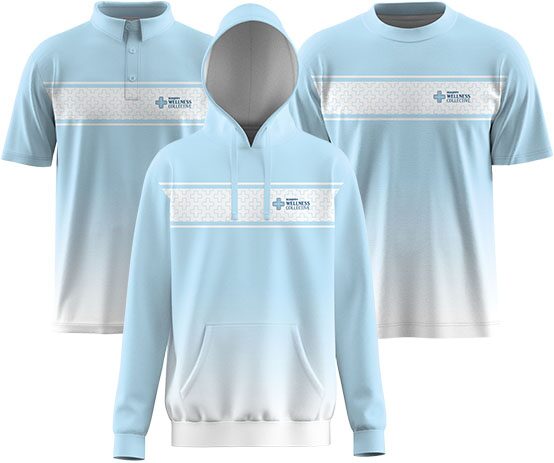
Healthcare organizations employ far more than clinical staff. Administrators, marketing teams, IT departments, facilities crews, volunteer coordinators, and community outreach specialists keep operations running. These teams don’t wear clinical attire, but they still represent the organization, and branded apparel helps unify them under a shared identity.
Healthcare screen printing programs give non-clinical staff a visible connection to the mission, whether they’re working a health fair, attending a conference, or simply walking through the main lobby.
Beyond Clinical Wear
Hospitals and healthcare networks face a unique apparel challenge. Clinical staff have clear uniform requirements driven by safety and sanitation standards. But administrative and support teams often default to business casual with no branded element at all.
That disconnect matters. When a volunteer wears a plain shirt at a community event, attendees don’t immediately recognize them as part of the organization. When the marketing team attends a conference in mismatched attire, brand presence suffers.
Healthcare workwear for non-clinical teams fills this gap. Branded polos, t-shirts, and outerwear create cohesion without interfering with clinical dress codes.
Staff Recognition Programs
Healthcare organizations increasingly use apparel as part of staff recognition. Years-of-service awards, employee appreciation weeks, and department milestones all present opportunities for branded merchandise.
A screen-printed t-shirt commemorating a team’s contribution to a successful initiative gets worn repeatedly, reinforcing the moment long after the event.
Healthcare screen printing allows for customization for every department. Oncology, cardiology, pediatrics, and behavioral health teams can each receive apparel with department-specific designs while maintaining consistent organizational branding. This personalization makes recognition feel meaningful rather than generic.
Team Building and Internal Events
Healthcare systems run dozens of internal events annually: charity walks, wellness challenges, team retreats, and training days. Branded apparel turns participants into a visible unit.
When five hundred employees walk a charity 5K in matching t-shirts, the organization’s presence is unmistakable. When a department retreat includes branded hoodies, participants leave with something tangible that reinforces team connection.
These applications don’t require complex apparel programs. A single bulk order of screen-printed t-shirts, sized appropriately across the group, handles most internal events effectively.
Community Health Events and Outreach
Healthcare networks serve communities beyond their walls. Health fairs, vaccination clinics, school wellness visits, and senior center programs all put staff in public-facing situations.
Healthcare workwear at these events serves two purposes: identification and trust. Community members need to quickly identify who’s there to help. Branded polos or t-shirts with clear logo placement accomplish this instantly.
For outdoor events, hats add visibility and sun protection. Staff working summer health fairs or mobile clinic programs benefit from branded caps that keep them recognizable across crowded venues.
Choosing the Right Production Approach
Healthcare apparel programs vary in scale. A small clinic ordering fifty polos for front desk staff has different requirements than a regional network ordering thousands of garments across multiple facilities.
For smaller orders on cotton or cotton-blend garments, screen printing handles most applications. Specialty inks like discharge and water-based prints create comfortable, breathable shirts suitable for long shifts.
For larger uniform programs, particularly those involving performance fabrics, sublimation printing on polyester/spandex blends provides durable, all-over graphics that hold up through heavy laundering.
Sizing and Distribution Logistics
Healthcare organizations employ diverse workforces, and sizing runs wide. An effective apparel program accounts for this from the start.
Rather than ordering equal quantities across sizes, experienced healthcare buyers use historical data or department surveys to build accurate size curves. This prevents shortages in common sizes and excess inventory in outliers.
Distribution also requires planning. Multi-facility networks may need orders shipped to individual locations rather than a central warehouse. A production partner with fulfillment capabilities can pack orders by department or facility, reducing internal sorting time.
Building a Repeatable Program
Staff turnover, new hires, and annual events mean healthcare apparel isn’t a one-time purchase. Organizations that treat healthcare workwear as an ongoing program, rather than isolated orders, can save time and maintain consistency.
Working with a production partner who stores artwork and specifications simplifies reorders. When the annual charity walk returns next year, the order process takes days instead of weeks.
Standardizing garment selections also helps. If every department uses the same polo style, inventory management and reordering become predictable.
Healthcare networks already manage enormous operational complexity. Branded apparel for recognition, team building, and community outreach doesn’t need to add to it. With the right planning and production partner, it becomes a straightforward extension of organizational identity.
About the Author