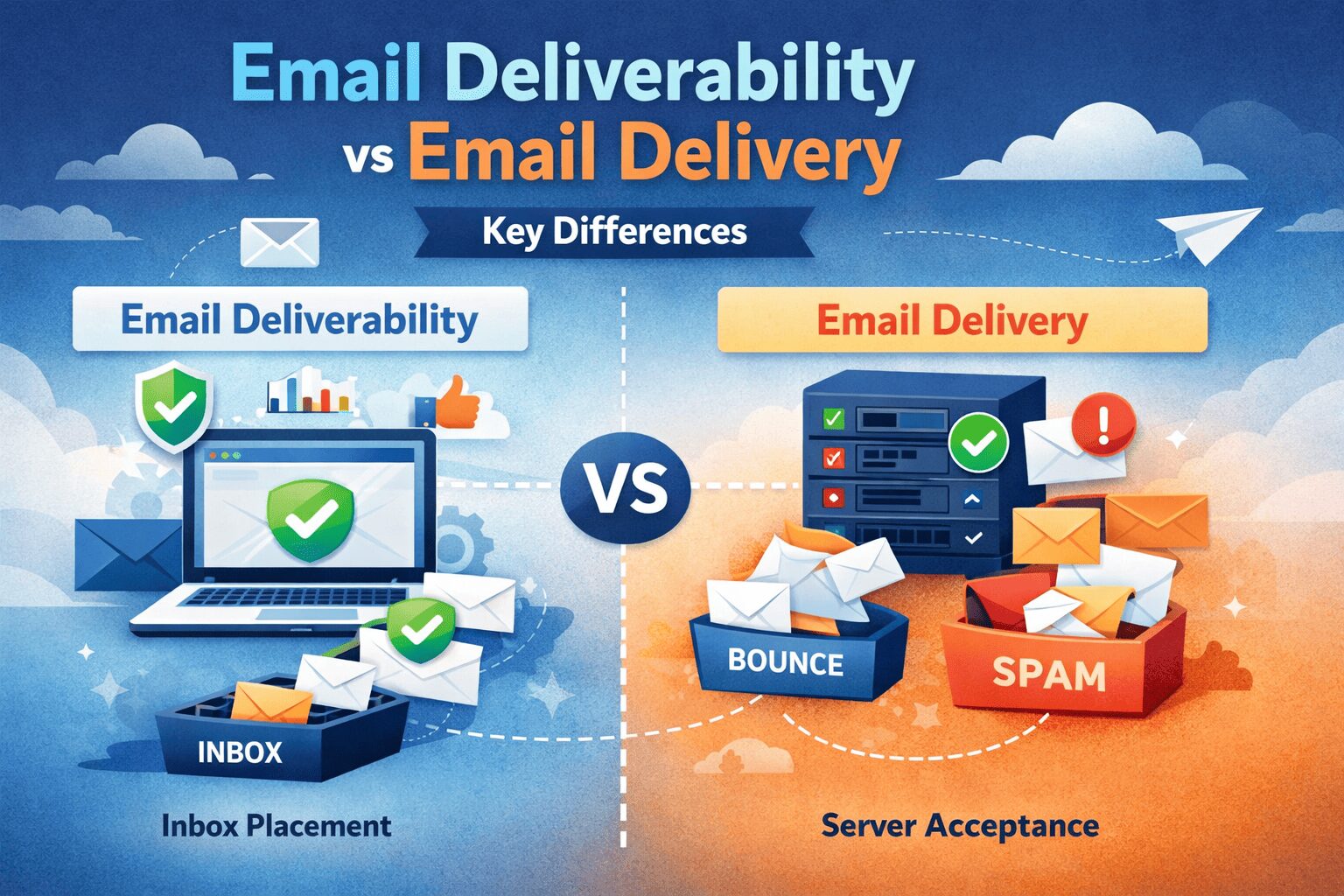
Email marketing remains one of the most powerful tools for businesses to connect with their audience, build relationships, and drive conversions. However, many marketers often confuse two critical concepts that determine the success of their email campaigns: email delivery and email deliverability. While these terms may sound similar, they represent very different aspects of email performance. Understanding the distinction between them is essential for anyone looking to run effective email campaigns and achieve consistent results.
Email delivery refers to whether an email successfully reaches the recipient’s mail server, while email deliverability focuses on whether that email actually lands in the recipient’s inbox instead of being filtered into spam or blocked entirely. This subtle but significant difference can determine whether your message is seen or ignored. In this article, we will explore these concepts in depth, explain their differences, and highlight why both are crucial for successful email marketing.
What is Email Delivery?
Email delivery is the basic measure of whether an email has been accepted by the recipient’s mail server. When you send an email, it travels through various servers before reaching its destination. If the receiving server accepts the email without rejecting it, the message is considered delivered. This does not guarantee that the email has reached the inbox; it simply means that it has not bounced back.
The delivery rate is usually expressed as a percentage and is calculated based on the number of emails sent versus the number of emails that did not bounce. A high delivery rate indicates that your email list is relatively clean and that your emails are technically reaching their destination servers. However, it does not provide insight into whether recipients actually see or engage with your emails.
Delivery is influenced by factors such as valid email addresses, proper server configuration, and the absence of technical errors. For example, if you send emails to invalid addresses, they will bounce, reducing your delivery rate. Similarly, issues like incorrect DNS settings or server misconfigurations can prevent emails from being delivered at all.
What is Email Deliverability?
Email deliverability goes a step further by focusing on where your email ends up after it has been delivered. It measures the likelihood of your email landing in the recipient’s inbox rather than in the spam or junk folder. Deliverability is a more complex and nuanced metric because it depends on multiple factors, including sender reputation, email content, user engagement, and authentication protocols.
Even if your emails have a high delivery rate, poor deliverability can significantly reduce their effectiveness. Emails that end up in spam folders are less likely to be opened, read, or acted upon. Therefore, deliverability is often considered the true measure of email marketing success.
Several elements influence deliverability, such as the quality of your email list, the relevance of your content, and the reputation of your sending domain. Internet Service Providers (ISPs) use sophisticated algorithms to determine whether an email is trustworthy. These algorithms analyze factors like spam complaints, bounce rates, and engagement levels to decide whether your email deserves a place in the inbox.
Key Differences Between Email Delivery and Email Deliverability
Understanding the differences between email delivery and email deliverability is crucial for optimizing your email campaigns. While both metrics are important, they serve different purposes and provide different insights into your campaign performance.
Email delivery focuses on the technical aspect of sending emails. It answers the question: “Did the email reach the recipient’s server?” On the other hand, email deliverability addresses the quality aspect. It answers the question: “Did the email reach the recipient’s inbox?”
Another key difference lies in how these metrics are measured. Delivery rates are relatively straightforward and are calculated based on bounced versus successfully sent emails. Deliverability, however, is harder to measure because it involves tracking inbox placement, which is not always directly visible.
The impact of these metrics also differs. A high delivery rate ensures that your emails are not being rejected outright, but it does not guarantee engagement. Deliverability, however, directly affects open rates, click-through rates, and overall campaign success.
Why Email Delivery Alone is Not Enough
Many marketers mistakenly believe that a high delivery rate guarantees the success of their campaigns. However, this is not the case. Emails can be successfully delivered to a server but still end up in spam folders, where they are unlikely to be noticed by recipients.
Focusing solely on delivery can create a false sense of success. For example, you might see a 98 percent delivery rate and assume your campaign is performing well. However, if a significant portion of those emails is being filtered into spam, your actual engagement will be much lower than expected.
This is why it is essential to look beyond delivery metrics and pay close attention to deliverability. By doing so, you can ensure that your emails not only reach their destination but also have a chance to be seen and acted upon.
Factors That Affect Email Deliverability
Email deliverability is influenced by a wide range of factors, many of which are interconnected. One of the most important factors is sender reputation. ISPs assign a reputation score to your domain and IP address based on your sending behavior. A good reputation increases the likelihood of your emails landing in the inbox, while a poor reputation can lead to spam filtering.
Another critical factor is email authentication. Protocols such as SPF, DKIM, and DMARC help verify that your emails are legitimate and not spoofed. Proper authentication builds trust with ISPs and improves your chances of achieving good deliverability.
Content quality also plays a significant role. Emails that contain spammy language, excessive links, or misleading subject lines are more likely to be flagged as spam. Additionally, user engagement is a key indicator of email quality. Emails that receive high open and click rates signal to ISPs that your content is valuable, improving your deliverability over time.
List hygiene is equally important. Sending emails to inactive or invalid addresses can harm your reputation and reduce deliverability. Regularly cleaning your email list and removing unengaged subscribers can help maintain a healthy sender reputation.
How to Improve Email Performance
To achieve success in email marketing, it is essential to focus on both delivery and deliverability. While delivery ensures that your emails are technically sent, deliverability ensures that they are actually seen by your audience. Striking the right balance between these two aspects can significantly enhance your campaign results.
In the middle of optimizing your campaigns, many marketers begin to realize the importance of strategies that help Improve email deliverability, as this directly impacts inbox placement and engagement. By adopting best practices such as maintaining a clean email list, using proper authentication methods, and creating relevant content, you can improve both delivery and deliverability.
Consistency is another key factor. Sending emails at regular intervals and maintaining a predictable sending pattern can help build trust with ISPs. Additionally, monitoring your email metrics and making data-driven adjustments can further enhance your performance.
Common Misconceptions
One common misconception is that email delivery and email deliverability are the same. While they are closely related, they represent different stages of the email journey. Another misconception is that high delivery rates guarantee high engagement, which is not necessarily true.
Some marketers also believe that once an email is delivered, their job is done. In reality, ensuring that the email reaches the inbox and resonates with the recipient is equally important. Ignoring deliverability can lead to missed opportunities and lower returns on investment.
Conclusion
Email delivery and email deliverability are both essential components of successful email marketing, but they serve different purposes. Delivery focuses on whether your emails reach the recipient’s server, while deliverability determines whether those emails make it to the inbox. Understanding this distinction can help you make more informed decisions and optimize your campaigns for better results.
By paying attention to both metrics and implementing best practices, you can ensure that your emails not only reach their destination but also engage your audience effectively. In a competitive digital landscape, mastering these concepts can give you a significant advantage and help you achieve long-term success in your email marketing efforts.
About the Author