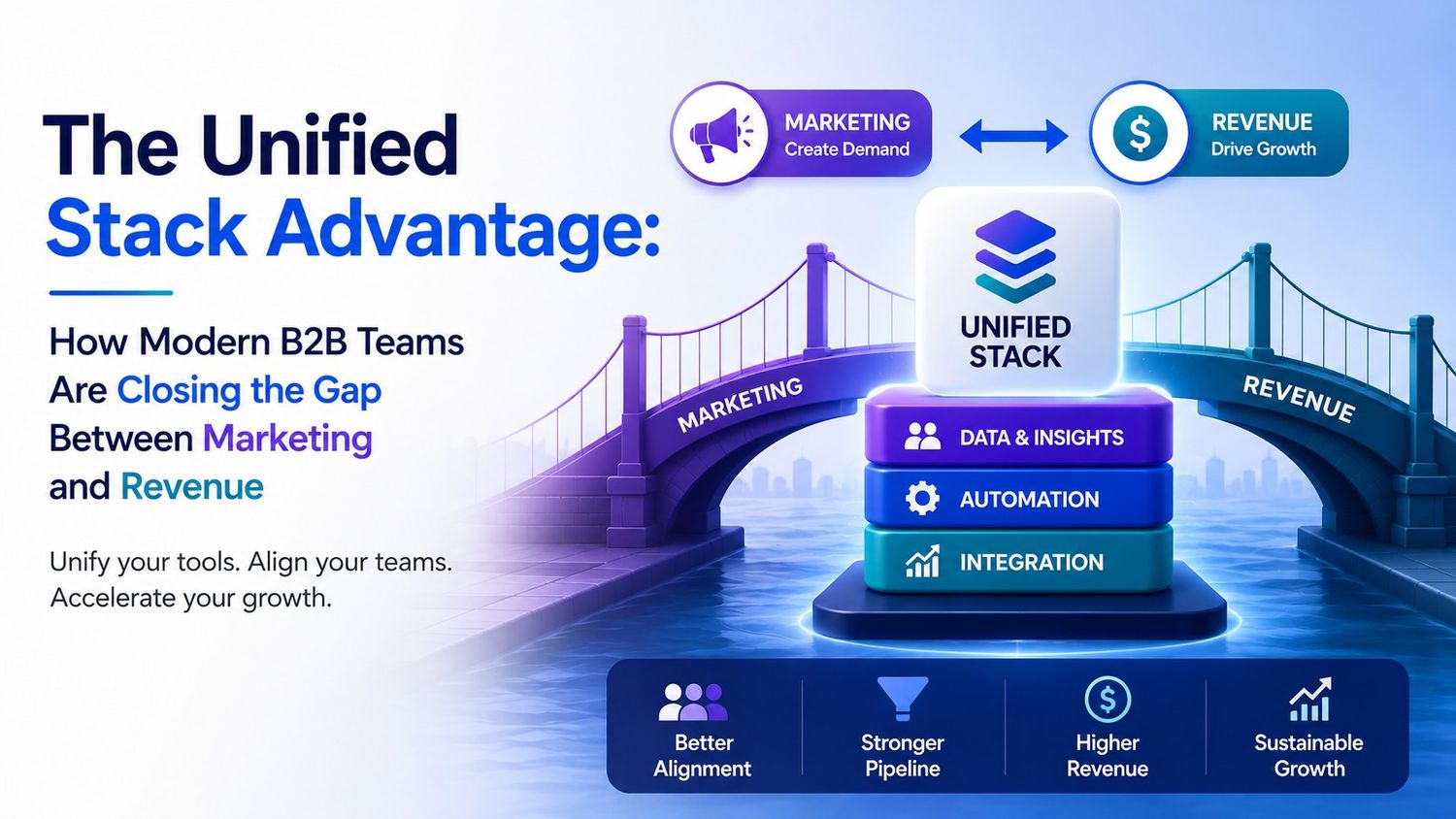
Let’s be honest, most B2B marketing teams are not losing because their people are not good enough. They’re losing because their tools don’t talk to each other.
Your CRM sits in one corner, your CMS in another. Your email platform has its own login, your analytics live in a third dashboard, and somewhere in between, a lead falls through the cracks quietly without anyone noticing until it shows up in a missed revenue report.
This is the reality for a staggering number of businesses. According to a 2024 DATAVERSITY survey, 68% of organizations cite data silos as their top operational concern, up 7% from the year before. And the financial toll? Research from Netguru puts it plainly: disconnected tools waste 12 hours of employee time every single week, while revenue leakage drains up to 5% of annual EBITA.
That’s not a small inefficiency. That’s a structural problem, and the companies solving it are pulling ahead.
This is where the unified stack advantage comes in. And right now, no platform embodies this advantage more concretely than HubSpot.
The Problem with Point Solutions
For years, the dominant logic in B2B tech was “best of breed.” Pick the best CRM. Pick the best email tool. Pick the best landing page builder. Stack them together and call it a strategy.
The result? By 2025, the average B2B sales representative was juggling 14 different tools daily and spending 27% of their time on administrative tasks instead of actually selling. Meanwhile, 65.7% of organizations report data integration difficulties as an active, ongoing challenge.
The tools weren’t the problem. The fragmentation was.
When your CRM doesn’t know what your CMS is doing, when your automation workflows are blind to what’s happening on your website, and when your sales team can’t see which emails marketing has already sent, you’re not running a marketing operation. You’re running five separate ones, poorly coordinated, with each gap costing you money.
A McKinsey analysis found that companies with fragmented marketing and sales systems lose 15-20% of their potential pipeline due to poor lead handovers and inconsistent customer communication alone. That’s revenue sitting on the table, unclaimed.
What “Unified” Actually Means in Practice
The word “unified” gets thrown around a lot in the software industry. Every vendor claims integration. But there’s a meaningful difference between tools that technically connect via API and a platform that was built from the ground up as a single system.
A truly unified stack means one database, one contact record, and one source of truth that every team (marketing, sales, and service) reads from and writes to simultaneously. It means that when a prospect clicks an email, visits a pricing page, and fills out a form, those three events are automatically linked to a single contact profile, scored, routed, and acted upon, without a human manually stitching that data together in a spreadsheet.
That’s the environment that proper HubSpot development services are designed to build. Not just a HubSpot portal that’s been switched on and left to default settings, but a thoughtfully architected system where every hub (marketing, sales, service, and content) is configured to work as one organism rather than a collection of features.
And when it works correctly, the results are not incremental. According to an IDC white paper on HubSpot Marketing Hub, companies that implement the platform properly see a 505% return on investment over three years and reach payback on their investment in as little as four months.
Where Automation Changes the Entire Equation
One of the most significant competitive advantages available to B2B teams today isn’t headcount; it’s the intelligent use of automation. And this is an area where the gap between well-implemented and poorly implemented platforms is particularly wide.
HubSpot automation services, when deployed with strategic intent, do something fundamental: they eliminate the lag between a buyer signal and a business response. Think about the typical journey of a lead without automation. A prospect downloads a whitepaper on a Tuesday afternoon. By the time a sales rep follows up on Thursday morning, the buying intent has cooled, a competitor has already been in touch, and the opportunity that existed 36 hours ago looks very different.
Now think about the same journey inside a properly configured HubSpot environment. The download triggers immediate enrollment in a nurture sequence tailored to that specific content. Their lead score updates in real time. If they hit a threshold, say, they visit the pricing page within 24 hours, a task is automatically created for the assigned sales rep, and a Slack notification is fired. The rep follows up within the hour, armed with full context, while the intent is still warm.
That’s not a hypothetical. HubSpot’s own data shows that users experience a 129% increase in inbound leads after one year, a 50% improvement in deals closed, and a 68% reduction in the time it takes to launch campaigns. These numbers come from the same platform; they’re just the difference between automation being thoughtfully configured and automation being an afterthought.
In 2025, 40% of marketers report having mostly or fully automated customer journeys. The 60% who haven’t are not just missing an efficiency gain; they’re actively ceding ground to competitors who have.
The Migration Moment: Why So Many Teams Are Making the Move Now
Here’s something worth saying directly: the decision to migrate to a unified platform is not primarily a technology decision. It’s a business strategy decision about how you want to grow.
HubSpot migration services are in demand right now, not because HubSpot is new; it’s been around for nearly two decades, but because a very specific type of company is reaching a very specific inflection point. They’ve been running on WordPress and a patchwork of plugins or on Salesforce with a separate marketing automation tool bolted on, and they’re hitting a ceiling. Not a capability ceiling, but an operational one. Too many handoffs. Too much manual work. Too many places where data gets lost.
The CRM market reflects this shift. HubSpot now holds approximately 38% of the global marketing automation market, serves over 258,000 paying customers across 135 countries, and reported over $3 billion in revenue in 2025. That’s not the profile of a tool companies are experimenting with; it’s the profile of a platform companies are betting their growth strategies on.
And a significant portion of that growth is coming from migration. Companies moving from WordPress, Drupal, Webflow, and legacy CMS platforms are choosing HubSpot CMS migration services specifically because they want their website to be part of the same system as their CRM, not a separate entity that has to be manually reconciled every month.
What makes a CMS migration worth doing well rather than quickly is SEO preservation, design continuity, and, critically, making sure that every conversion element on the new site feeds directly into the CRM with clean data mapping. Done right, a migration isn’t just a platform change. It’s a foundation reset that the entire growth operation can be built on top of.
The Real Competitive Advantage Isn’t the Platform; It’s the Implementation
An uncomfortable truth that most platform vendors won’t tell you is that the technology is the easiest part.
HubSpot is not a difficult platform to turn on. It’s a very difficult platform to configure well. The difference between a HubSpot portal that generates ROI and one that becomes an expensive glorified contact database comes down almost entirely to how deeply the implementation was thought through.
This is why professional HubSpot development services have become central to how serious B2B companies approach the platform. Not as a setup task that gets handed to an intern for a week, but as a strategic engagement that maps the platform to business logic, the specific way this company qualifies leads, the specific stages in this company’s sales cycle, and the specific triggers that should move a contact from marketing ownership to sales ownership.
When that kind of intentional development meets the right automation architecture, the unified stack stops being a technology investment and becomes a competitive moat.
Think about what it means to have every sales rep start every call with complete context. To have your marketing team able to see (in real time) which content is actually influencing the pipeline, not just generating traffic. To have customer service teams who can see the entire pre-purchase journey of every contact they’re helping. That’s not a feature set. That’s organizational intelligence.
Closing the Gap Starts With One Decision
The gap between marketing and revenue in most B2B organizations is not a talent problem. It’s not a strategy problem. It’s an infrastructure problem, and infrastructure problems have infrastructure solutions.
The teams that are closing this gap are making a deliberate choice: to stop managing tools and start operating a system. They’re investing in thoughtful HubSpot development services rather than default setups. They’re deploying HubSpot automation services not to save time on emails, but to compress the lag between buyer intent and sales response. And when their existing platform is holding them back, they’re committing to proper HubSpot migration services, or HubSpot CMS migration services specifically, not as a lift-and-shift exercise but as a strategic re-architecture.
The unified stack advantage is real. The data is unambiguous. The question is not whether the platform can close the gap between marketing and revenue.
The question is whether your implementation of it will.
About the Author