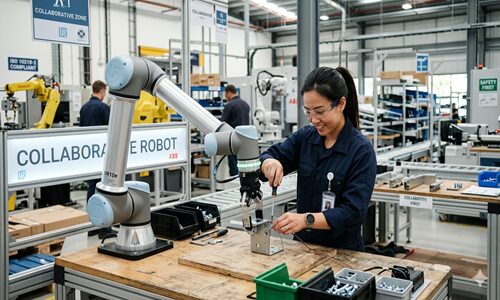
The industrial landscape is undergoing a profound transformation, moving away from the era of isolated, caged machinery toward a future defined by seamless human-machine synergy. At the heart of this evolution is the collaborative robot, or “cobot.” Designed to work safely alongside human operators without the need for traditional safety fencing, cobots are redefining productivity, safety, and flexibility across diverse sectors.
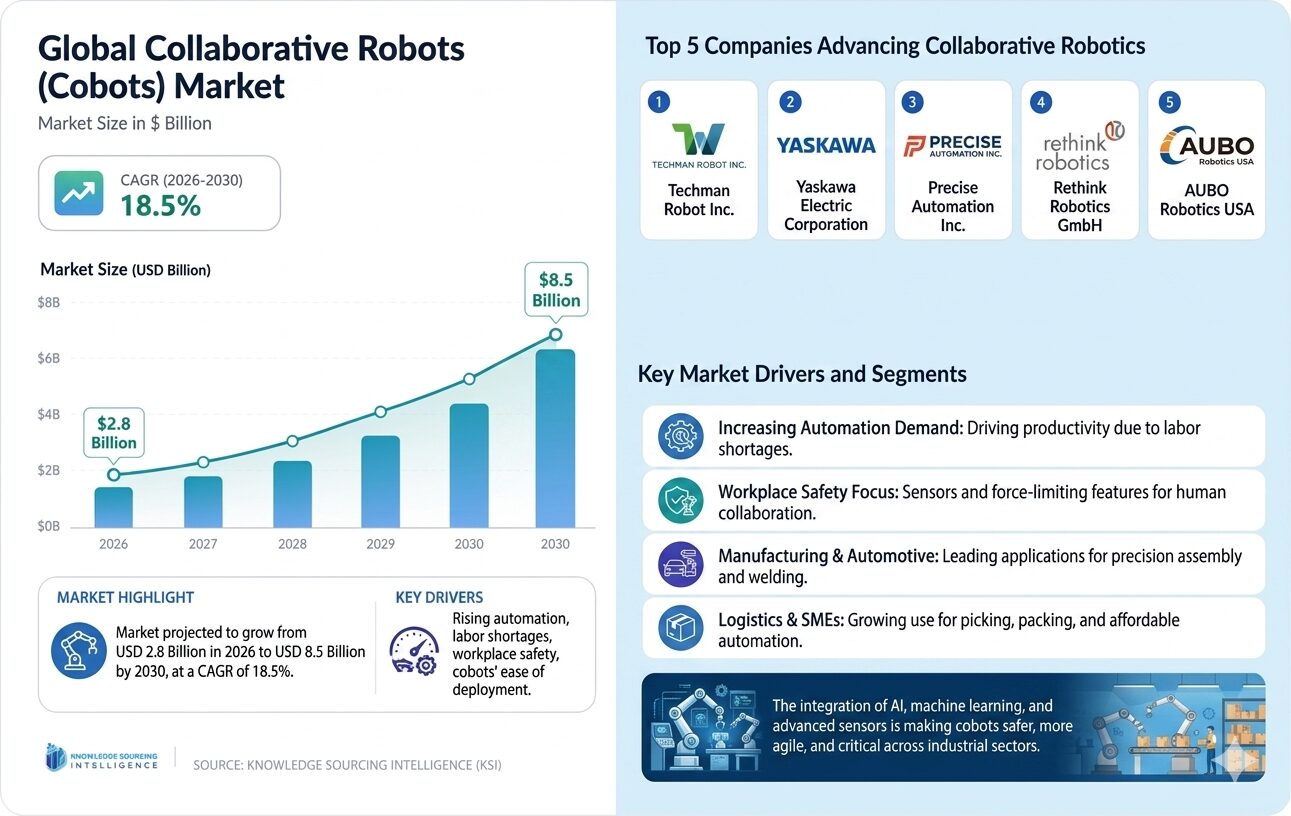
Global Collaborative Robots Market forecast to hit USD 8.3 billion by 2030 from USD 4.5 billion in 2025, at 12.8% CAGR. Major players: Techman Robot Inc., Yaskawa Electric Corporation, Precise Automation Inc., Rethink Robotics GmbH, AUBO Robotics USA.
The Dawn of Collaborative Automation
For decades, industrial robots were synonymous with massive, high-speed machines bolted to factory floors, performing repetitive tasks in isolation. While effective, these systems required significant space, high capital investment, and specialized programming. The emergence of collaborative robots has dismantled these barriers.
Cobots are characterized by their advanced sensors, force-limiting capabilities, and intuitive interfaces. Unlike their traditional counterparts, they can detect human touch or proximity and react instantaneously to prevent injury. This inherent safety allows them to be integrated into existing workflows where space is a premium and human dexterity is still required for complex decision-making.
Market Dynamics: Drivers of Growth
Several key factors are propelling the global collaborative robots market toward its projected 2030 valuation:
Labor Shortages and Rising Wage Costs: Manufacturing hubs across North America, Europe, and parts of Asia are facing a shrinking workforce. As older generations retire and younger workers seek roles outside of traditional manufacturing, companies are turning to cobots to fill the gap. Cobots handle the “3Ds”—tasks that are dull, dirty, or dangerous—freeing up humans for high-value roles.
Affordability and ROI: One of the most significant advantages of cobots is their lower total cost of ownership. They are generally less expensive than heavy industrial robots and do not require the costly peripheral safety infrastructure. Small and Medium Enterprises (SMEs), which were previously priced out of automation, are now leading adopters.
Flexibility and Ease of Use: Modern cobots feature “lead-through” programming, where a worker can physically move the robot arm to teach it a path. This eliminates the need for complex coding, allowing production lines to be reconfigured in hours rather than days.
Advancements in AI and Vision Systems: The integration of Artificial Intelligence (AI) and 3D vision has endowed cobots with the ability to “see” and “think.” They can now perform pick-and-place tasks with unsorted items, conduct quality inspections with microscopic precision, and adapt to changes in their environment in real-time.
Key Market Segments and Applications
The versatility of collaborative robots allows them to permeate various industries, each finding unique value in human-robot collaboration.
Automotive
The automotive sector remains a primary driver. Cobots are used for assembly tasks, such as installing door panels or applying adhesives, where they work in tandem with technicians. Their ability to maintain consistent pressure and precision reduces defects and ergonomic strain on workers.
Electronics and Semiconductors
In the electronics industry, where components are becoming increasingly miniaturized, cobots provide the steady “hands” required for soldering, testing, and packaging. Their high repeatability ensures that delicate circuits are handled without damage.
Food and Beverage
Cobots are increasingly found in food processing plants, performing tasks like primary packaging, palletizing, and even food preparation. With wash-down capabilities and food-grade lubricants, they meet stringent hygiene standards while maintaining high throughput.
Healthcare and Pharmaceuticals
Beyond the factory floor, cobots are making inroads into laboratories and hospitals. They assist in the high-speed sorting of test tubes, the precise dispensing of medications, and even in physical therapy, where they can provide consistent, measured resistance for patient exercises.
Competitive Landscape: Leading the Charge
The collaborative robots market is characterized by a mix of established industrial giants and innovative specialized firms.
Techman Robot Inc.: A leader in “smart” cobots, Techman integrates vision systems directly into the robot hardware. This “all-in-one” approach simplifies deployment and enables the robots to perform complex visual tasks without external cameras.
Yaskawa Electric Corporation: A titan in the robotics industry, Yaskawa has expanded its MOTOMAN line to include sophisticated collaborative models. Their focus on high-speed performance combined with safety makes them a preferred choice for heavy-duty collaborative tasks.
Precise Automation Inc.: Specializing in life sciences and laboratory automation, Precise Automation focuses on extremely safe, low-power cobots that can operate in confined spaces alongside researchers.
Rethink Robotics GmbH: As a pioneer in the field, Rethink continues to innovate with its Sawyer Black Edition. Their robots are known for their expressive “eyes” that signal intent to human coworkers, enhancing the collaborative experience.
AUBO Robotics USA: AUBO has gained significant traction by offering modular and highly customizable cobots. Their focus on an open software ecosystem allows developers to create specialized applications for niche industries.
Regional Outlook
Asia-Pacific: This region is expected to maintain the largest market share through 2030. China, Japan, and South Korea are investing heavily in “Smart Manufacturing” initiatives. China’s push to upgrade its industrial base and Japan’s response to an aging population are critical catalysts.
Europe: Driven by Germany’s “Industry 4.0” framework, Europe is a hub for cobot innovation. Strict labor laws and a high focus on worker ergonomics make cobots an attractive investment for European manufacturers.
North America: The U.S. is seeing a surge in cobot adoption as companies look to “reshore” manufacturing. By automating processes, American firms can compete with lower-cost labor markets abroad while maintaining high quality.
Challenges and Future Trends
Despite the optimistic forecast, the market faces hurdles. Technical limitations regarding payload and speed still exist; cobots are generally slower and carry lighter loads than traditional robots to ensure safety. Furthermore, as cobots become more interconnected, cybersecurity becomes a paramount concern.
Looking toward 2030, we expect to see:
Increased Mobility: The marriage of cobots and Autonomous Mobile Robots (AMRs) will create “mobile manipulators” that can navigate warehouses independently to perform tasks at different stations.
Enhanced Haptics: Improved force-feedback technology will allow cobots to handle even more fragile materials, such as organic produce or thin glassware.
Edge Computing: Processing data locally on the robot will reduce latency, allowing for even faster safety responses and more complex AI-driven decision-making.
Conclusion
The Global Collaborative Robots Market is not just growing; it is maturing. The leap from USD 4.5 billion in 2025 to USD 8.3 billion in 2030 represents more than just financial success—it signals a fundamental shift in how humanity views labor. By delegating repetitive and strenuous tasks to cobots, we are unlocking human potential for creativity, strategy, and innovation. As technology continues to lower the barrier to entry, the collaborative revolution will reach every corner of the global economy, making “working with a robot” as commonplace as working with a computer.
About the Author