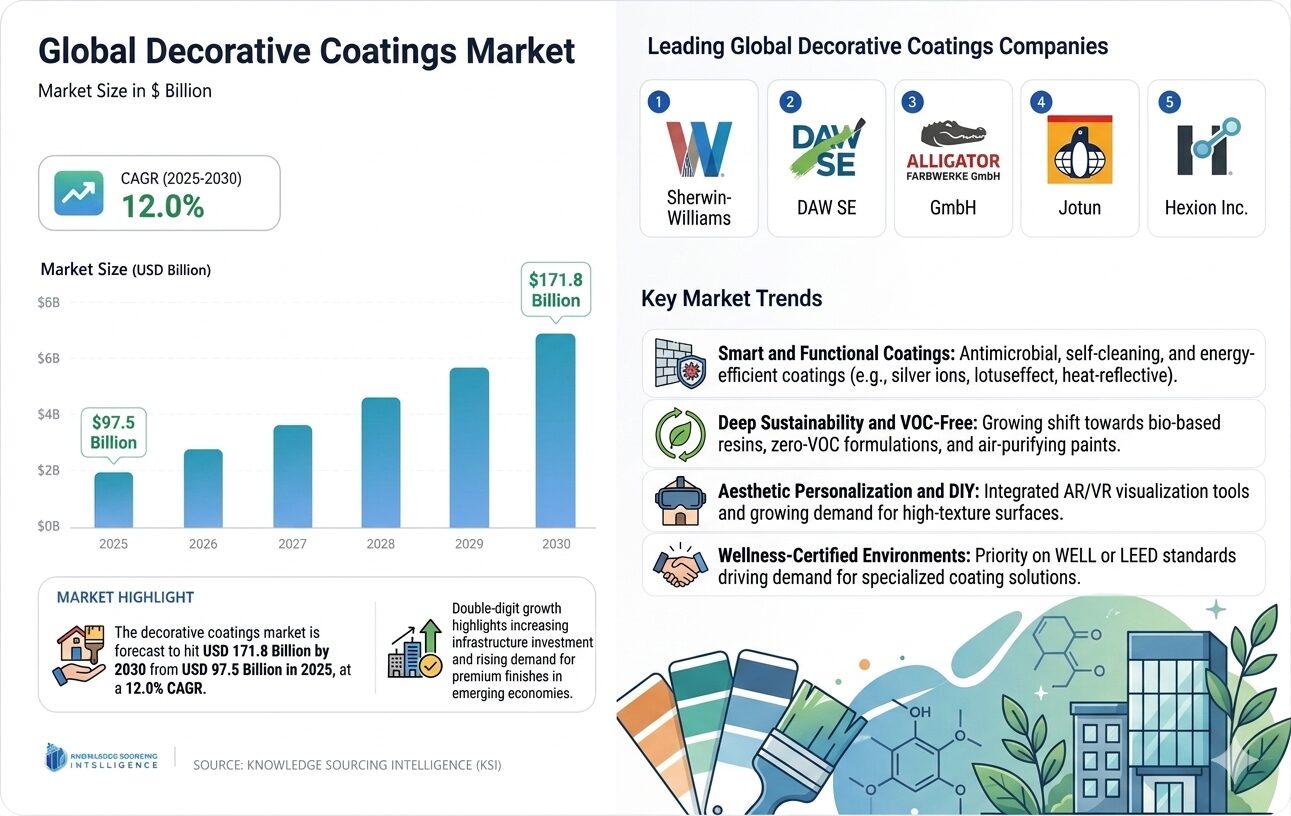
The global decorative coatings industry is undergoing a monumental shift, evolving from a traditional aesthetic-focused sector into a high-tech, sustainability-driven powerhouse. As of 2025, the market has reached a valuation of USD 97.5 billion, and it is on a trajectory to redefine the architectural landscape of both residential and commercial spaces. By 2030, the market is forecast to hit USD 171.8 billion, growing at a robust CAGR of 12.0%.
This growth is fueled by a convergence of technological innovation, stringent environmental regulations, and a fundamental change in consumer expectations. Modern decorative coatings are no longer just about color; they are now engineered to improve indoor air quality, reduce energy consumption, and provide long-term protection against microbial threats.
Market Overview and Growth Trajectory
The decorative coatings market is forecast to hit USD 171.8 billion by 2030 from USD 97.5 billion in 2025, at 12.0% CAGR. Major players: Sherwin-Williams, DAW SE, ALLIGATOR FARBWERKE GmbH, Jotun, Hexion Inc.
This double-digit growth rate highlights the increasing investment in infrastructure and the rising demand for premium finishes in emerging economies. While the residential sector remains the largest consumer, the commercial segment is rapidly expanding as businesses prioritize wellness-certified environments (such as WELL or LEED standards) that require specialized coating solutions.
Key Trends Shaping the Future of Decorative Coatings
1. The Rise of “Smart” and Functional Coatings
The most significant trend entering 2026 is the transition toward functional smart coatings. These materials do more than sit on a surface; they interact with the environment.
Antimicrobial and Antiviral Surfaces: Following global health shifts, there is a surge in coatings containing silver ions or photocatalytic technology that actively neutralize bacteria and viruses on walls.
Self-Cleaning and Hydrophobic Tech: Innovations in nanotechnology have led to “lotus-effect” coatings. These surfaces repel water and dirt, allowing exterior facades of high-rise commercial buildings to stay clean with simple rainwater, drastically reducing maintenance costs.
Energy-Efficient Reflective Coatings: In commercial spaces, cool-roof and heat-reflective wall coatings are becoming standard. By reflecting infrared radiation, these coatings can reduce indoor temperatures by several degrees, lowering HVAC energy loads.
2. Deep Sustainability and VOC-Free Formulations
Regulatory pressure in Europe and North America has pushed the industry toward a “Green-First” approach.
Bio-based Resins: Companies like Hexion Inc. are pioneering the use of plant-derived resins to replace petroleum-based components. These bio-coatings offer a lower carbon footprint without compromising durability.
Zero-VOC and Air-Purifying Paints: Volatile Organic Compounds (VOCs) are being phased out in favor of water-based emulsions. Beyond being “low-odor,” new formulations actually act as air scrubbers, absorbing formaldehyde and other indoor pollutants.
3. Aesthetic Personalization and Digital Integration
The “DIY” segment in the residential market is being transformed by digital tools.
Virtual Reality (VR) Visualization: Major players like Sherwin-Williams have integrated AR tools that allow homeowners to visualize complex textures and color palettes in real-time before a single drop of paint is purchased.
Texture and Special Effects: There is a growing trend toward “tactile” walls. Decorative coatings that mimic natural stone, raw concrete, or even suede are highly sought after in luxury commercial interiors and modern residential designs.
Sector Analysis: Residential vs. Commercial
Residential Trends:
Homeowners are increasingly viewing paint as a “wellness” investment. There is a marked shift toward matte finishes and earthy, “biophilic” tones that connect indoor spaces with nature. Furthermore, the rise of home offices has created a niche for acoustic-dampening coatings that help reduce sound transmission between rooms.
Commercial Trends:
In the commercial sector, durability is the primary driver. High-traffic areas such as hospitals, schools, and airports require coatings that can withstand frequent chemical cleaning. ALLIGATOR FARBWERKE GmbH and Jotun have been at the forefront of developing heavy-duty decorative finishes that provide the aesthetic of a high-end hotel with the resilience of industrial-grade protection.
Competitive Landscape and Strategic Movements
The market is dominated by a few global giants who are aggressively pursuing acquisitions to expand their technological portfolios.
Sherwin-Williams: Continues to lead through its massive retail footprint and recent innovations in “Living Well” paint collections that focus on health and comfort.
Jotun: A leader in the Middle East and Asia-Pacific, Jotun is focusing heavily on “Green Steps” initiatives, ensuring their decorative lines meet the highest global environmental certifications.
DAW SE & ALLIGATOR: These European-based leaders are setting the standard for ecological high-performance coatings, particularly in the renovation of historic and high-efficiency buildings.
Conclusion
The decorative coatings industry is at a crossroads where chemistry meets creativity. As we move toward 2030, the market’s expansion to USD 171.8 billion will be defined by its ability to solve environmental challenges while satisfying the human desire for beauty and expression. Whether through a self-healing exterior on a skyscraper or a formaldehyde-absorbing wall in a nursery, decorative coatings are fundamentally reshaping the spaces where we live and work.
About the Author