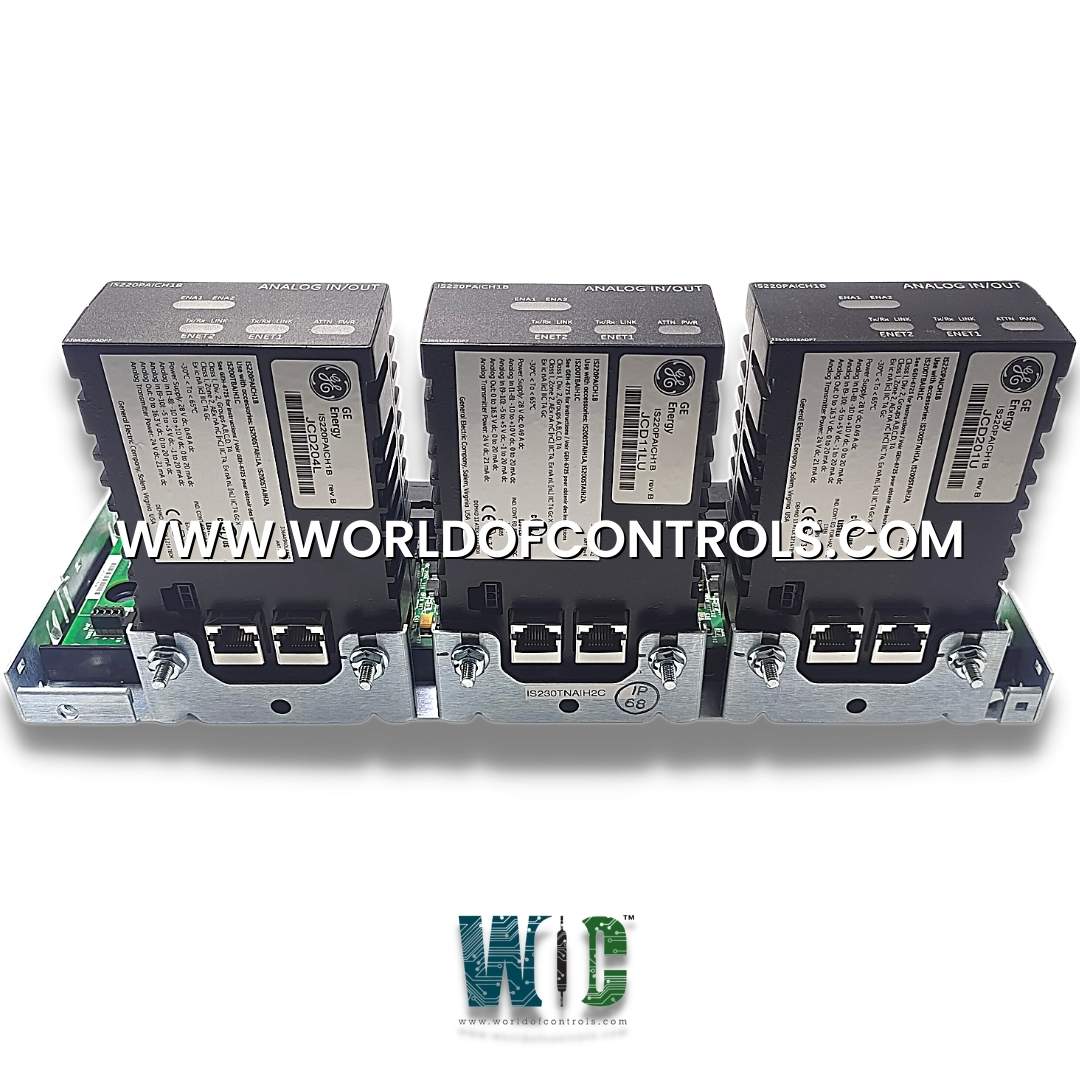
Introduction to Analog I/O in Industrial Automation
Industrial automation relies on the accurate exchange of data between physical processes and control systems. Analog Input/Output (I/O) modules are essential components in this process, as they translate real-world signals—such as temperature, pressure, flow, and vibration—into data that control systems can process. GE Analog I/O DIN-Rail Modules are widely adopted across industries due to their precision, reliability, and compatibility with advanced control platforms.
In high-demand sectors such as power generation and turbine control, these modules play a critical role in maintaining operational safety, efficiency, and performance.
Overview of GE Analog I/O DIN-Rail Modules
GE Analog I/O DIN-Rail Modules are compact, industrial-grade devices designed for installation on standard DIN rails within control panels. Their primary function is to interface between field instruments and control systems, including programmable logic controllers (PLCs) and distributed control systems (DCS).
Typical characteristics include:
Support for standard analog signal ranges (such as 4–20 mA and voltage signals)
High accuracy and signal stability
Robust design for harsh industrial environments
Seamless integration with GE automation and control architectures
These features make them suitable for continuous-process and mission-critical applications.
Role of Analog I/O Modules in Automation Systems
Analog I/O modules act as the bridge between physical equipment and digital control logic. Input modules collect signals from sensors installed in the field, while output modules transmit control signals to actuators such as valves, motors, and dampers.
Their core functions include:
Real-time process monitoring
Feedback control loop execution
Equipment diagnostics and condition monitoring
Data acquisition for analysis and optimization
Accurate signal handling ensures that automation systems respond correctly to changing process conditions.
Analog I/O Modules in the Turbine Industry
In the turbine industry, analog I/O DIN-rail modules are integral to gas and steam turbine control systems. They are commonly used within GE turbine control platforms deployed in power plants worldwide.
These modules process analog inputs from critical turbine instrumentation, including:
Temperature sensors monitoring turbine and exhaust conditions
Pressure transmitters for fuel, steam, and lubrication systems
Flow measurement devices for air, fuel, and cooling circuits
Vibration and condition-monitoring sensors
The data collected enables real-time monitoring, precise control, and protective decision-making throughout turbine operation, from startup to shutdown.
Key Applications in Turbine and Power Automation
Turbine Control and Performance Monitoring
Analog I/O modules support closed-loop control by providing accurate feedback to the turbine controller, helping optimize efficiency and load response.
Protection and Safety Systems
Reliable analog inputs allow early detection of abnormal conditions, enabling protective actions that prevent equipment damage and unplanned outages.
Balance of Plant Systems
Beyond the turbine itself, these modules are used in auxiliary systems such as fuel handling, lubrication, cooling, emissions control, and electrical systems.
System Expansion and Modernization
DIN-rail mounting allows flexible installation and easy replacement, making these modules well suited for upgrading or expanding existing turbine control systems.
Benefits of GE Analog I/O DIN-Rail Modules
Proven reliability in power generation environments
High signal accuracy for critical measurements
Modular design for simplified maintenance
Compatibility with GE turbine control platforms
These benefits support long-term operational stability and reduced downtime.
Conclusion
GE Analog I/O DIN-Rail Modules are essential building blocks in industrial automation, particularly within the turbine and power generation industries. By enabling precise measurement, reliable control, and effective protection, they contribute directly to safe and efficient turbine operation. Their flexibility and performance make them a key component in both new automation projects and modernization initiatives.
About the Author